Mississippian Fossils

Image credit: Wikimedia Commons
The Mississippian Period (Lower Carboniferous) spanned roughly 360–320 million years ago during the Paleozoic Era and is often called the “Age of Crinoids.” The name comes from rocks exposed in the Mississippi River valley near St. Louis, first recognized by geologist Alexander Winchell in 1870. Outside the United States, this interval is usually referred to as the Lower Carboniferous, from the Latin carbo (“coal”) – literally “coal-bearing.”
In the Louisville area, Mississippian rocks (from oldest to youngest) include the Early Mississippian (Kinderhookian) Jacobs Chapel Shale and thin Rockford Limestone, followed by Middle Mississippian (Osagean) units of the Borden Formation (New Providence Shale – including the Coral Ridge and Button Mold Knob members – Kenwood Siltstone, Nancy Member / Rosewood Shale, and Holtsclaw Siltstone), plus the Muldraugh Formation, Harrodsburg Limestone (Warsaw in older references), and Salem/Warsaw Limestone (with the Somerset Shale Member in the lower part of the Salem).
West and south of Louisville, additional Middle Mississippian (Meramecian) formations include the St. Louis and Ste. Genevieve limestones. Upper Mississippian (Chesterian) units include the Paoli Limestone, Bethel Formation (Indiana), Beaver Bend Limestone, Sample Sandstone, Reelsville Limestone, Elwren Formation, Beech Creek Limestone, Big Clifty Sandstone, Haney Limestone, Hardinsburg Sandstone, Glen Dean Limestone, Tar Springs Sandstone, Vienna Limestone, Buffalo Wallow Formation, and Kinkaid Limestone. The last four are sometimes grouped into the Leitchfield Formation. Eastern Kentucky uses a somewhat different set of formation names.
Scroll down and select the name of a particular fossil to view its image on its own page. Use your browser’s Back button to return to this page after viewing an image. Some images may be larger than your screen resolution; click on the image to expand it.
 Blastoids (Echinodermata)
- Granatocrinus kentuckyensis (Conkin), New Providence Shale, Jefferson Co., KY
- Pentremites buttsi Ulrich, with fluorite encrustation, Deardorff Mine Dump, Hardin Co., IL
- Pentremites conoideus Hall, ambulacral plate, Middle Mississippian, Salem Limestone, Floyd Co., IN
- Pentremites godoni – Wax, KY
- Pentremites patei Ulrich, with defective ambulacral groove, Upper Mississippian, Indian Springs Shale, Big Clifty Formation, Crawford Co., IN
- Pentremites pulchellus – Wax, KY
- Pentremites pyriformes – Wax, KY
- Pentremites sp. – Indian Springs Shale, Sulphur, Crawford Co., IN
- Pentremites symmetricus Hall, Indian Springs Shale, Sulphur, Crawford Co., IN
- Pentremites welleri Ulrich, Indian Springs Shale, Sulphur, Crawford Co., IN
- Tricoelocrinus woodmani (Meek & Worthen), Salem Limestone, Lanesville, Harrison Co., IN


 Brachiopods
- Beecheria formosa (Hall), Middle Mississippian, Salem Limestone, Floyd Co., IN
- Eumetria verneuiliana Hall, Middle Mississippian, Salem Limestone, Floyd Co., IN
- Marginirugous magnus (Meek & Worthen), Harrodsburg Limestone, Harrodsburg, Monroe Co., IN
- Orbiculoidea sp. (inarticulate), attached to crinoid stem, pyrite-replaced, Coral Ridge Member, New Providence Shale, Jefferson Co., KY
- Orthotetes keokuk (Hall), Borden Formation, Borden, Clark Co., IN
- Punctospirifer depressus – Wax, KY
- Spirifer sp. New Providence Formation, Button Mold Knob Member, Coral Ridge, Jefferson Co., KY


 Bryozoans (Moss Animals)
- Archimedes sp. bifurcated, Upper Mississippian, Indian Springs Shale, Sulphur, Crawford Co., IN
- Archimedes sp. Upper Mississippian, Indian Springs Formation, Sulphur, Crawford Co., IN
- Archimedes sp. Indian Creek Shale, Harrison Co., IN
- Cystodictya lineata Ulrich – Salem Limestone, Elizabethtown, Hardin Co., KY
- Fenestella sp. Middle Mississippian, Salem Limestone, Floyd Co., IN
- Fenestrate bryozoan Middle Mississippian, St. Louis Limestone, Corydon, Harrison Co., IN
- Lioclema sp. Middle Mississippian, Button Mold Knob Member, New Providence Shale, Jefferson Co., KY
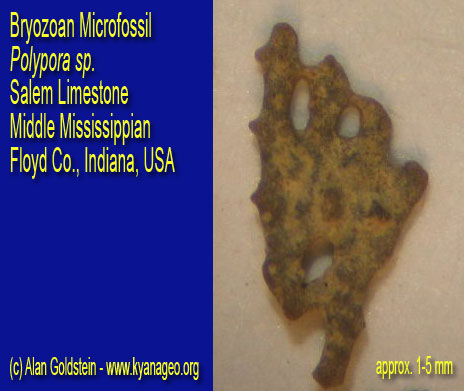
- Polypora sp. Middle Mississippian, Salem Limestone, Floyd Co., IN
- Rhombopora bedfordensis Cumings & Beede, Middle Mississippian, Salem Limestone, Floyd Co., IN



 Cephalopods (Mollusca)
- Cantabricanites? greenei (Miller), goniatite, Middle Mississippian, Coral Ridge Member, New Providence Formation, Jefferson Co., KY
- Coiled cephalopod geodized, New Providence Formation, Bullitt Co., KY
- Muensteroceras paralleum Kinderhookian, Rockford Limestone, Rockford, IN
- Polaricyclus ballardensis (McKenzie), goniatite, Middle Mississippian, Coral Ridge Member, New Providence Formation, Clark Co., IN
- Polaricyclus ballardensis (McKenzie), goniatite, Middle Mississippian, Coral Ridge Member, New Providence Formation, Clark Co., IN
- Sliced cephalopod Brodhead Formation, Horsefly Hollow, Bullitt Co., KY
- Winchelloceras knappi Work & Mason, goniatite, Middle Mississippian, Coral Ridge Member, New Providence Formation, Clark Co., IN


 Clams (Pelecypods / Mollusca)
- Microdon subellipticus? Whitfield, Middle Mississippian, Salem Limestone, Floyd Co., IN
- Myalina sp. with fenestrate bryozoans, Middle Mississippian, St. Louis Formation, Meade Co., KY


 Corals & Hydrozoans (Cnidaria)
- Acrocyathus sp. St. Louis Formation, Lincoln Co., KY
- Conularia sp. Borden Formation, Jefferson Co., KY
- Paraconularia sp. Middle Mississippian, Coral Ridge Member, New Providence Shale, Jefferson Co., KY
- Paraconularia sp. in nodule, Middle Mississippian, Coral Ridge Member, New Providence Shale, Jefferson Co., KY
- Unknown horn coral Indian Springs Shale, Sulphur, Crawford Co., IN


 Crinoids (Echinodermata)
- Abatocrinus grandis Fort Payne Formation, Lake Cumberland, Wayne Co., KY
- Actinocrinites? sp. with a small Scytalocrinus robustus (Hall) on the upper calyx
- Agaricocrinus sp. calyx, Fort Payne Formation, Burkesville, KY
- Agaricocrinus sp. calyx, Fort Payne Formation, Lake Cumberland, Wayne Co., KY
- Alloprosallocrinus conicus and Eretmocrinus magnificus Fort Payne Formation, Lake Cumberland, Wayne Co., KY
- Alloprosallocrinus sp. calyx, Fort Payne Formation, Portland, TN
- Batocrinus sp. Fort Payne Formation, Lake Cumberland, Wayne Co., KY
- Batocrinus icosadactylus Fort Payne Formation, Lake Cumberland, Wayne Co., KY
- Cactocrinus sp. Fort Payne Formation, Lake Cumberland, Wayne Co., KY
- Dizygocrinus indianaensis calyx, Fort Payne Formation, Lake Cumberland, Wayne Co., KY
- Dizygocrinus indianaensis bottom of calyx, Fort Payne Formation, Lake Cumberland, Wayne Co., KY
- Dorycrinus sp. calyx, Fort Payne Formation, Portland, Sumner Co., TN
- Eretmocrinus praegravis Fort Payne Formation, Lake Cumberland, Wayne Co., KY
- Eretmocrinus sp. calyx, Fort Payne Formation, Goose Creek, Clinton Co., KY
- Eucladocrinus sp. (little crinoid on the left is a Platycrinites sp.)
- Eucladocrinus kentuckensis Fort Payne Formation, Lake Cumberland, Wayne Co., KY
- Gilbertsocrinus tuberosus (Lyon & Casseday) with Cladochonus sp. coral in the upper left
- Onychocrinus ulrichi? Miller & Gurley; twisted column is a Platycrinites sp.
- Pachyocrinus aequalis (Hall), Borden Group, Muldraugh Formation, Crawfordsville, Montgomery Co., IN
- Paradichocrinus sp. Fort Payne Formation, Lake Cumberland, Wayne Co., KY
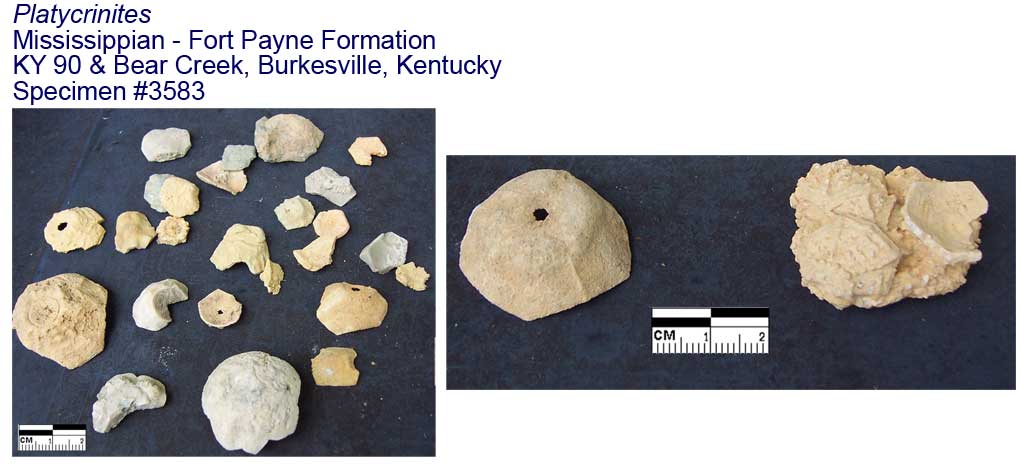
- Platycrinites sp. calyx, Fort Payne Formation, Burkesville, KY
- Teleocrinus umbrosus calyx, Fort Payne Formation, Lake Cumberland, Wayne Co., KY
- Teleocrinus umbrosus bottom of calyx, Fort Payne Formation, Lake Cumberland, Wayne Co., KY
- Teleocrinus umbrosus top of calyx, Fort Payne Formation, Lake Cumberland, Wayne Co., KY
- Uperocrinus pyriformis Fort Payne Formation, Lake Cumberland, Wayne Co., KY
- Zeacrinites sp. slightly crushed, Upper Mississippian, Indian Springs Shale Member, Big Clifty Formation, Crawford Co., IN




 Vertebrata: Pisces (Fish)
- Oracanthus sp. shark fin spine, Salem Formation, Georgetown, Floyd Co., IN
- Petalodus acuminatus shark tooth, Mississippian, Haney Formation, Sulphur, Crawford Co., IN
- Petalodus sp. shark tooth, Middle Mississippian, Salem Limestone, Washington Co., IN
- Symmorium sp. shark tooth, Upper Mississippian, Indian Springs Shale Member, Big Clifty Formation, Crawford Co., IN
- Symmorium sp. shark tooth, Middle Mississippian, Muldraugh Formation, Hardin Co., IN
- Unidentified fish spine? Indian Springs Formation, Sulphur, Crawford Co., IN


 Plant
Plant

 Snails (Gastropoda / Mollusca)
- Bellerophon sp. Morehead, KY
- Mourlonia sp. Morehead, KY
- Solenospira turritella (Hall), Middle Mississippian, Salem Limestone, Floyd Co., IN
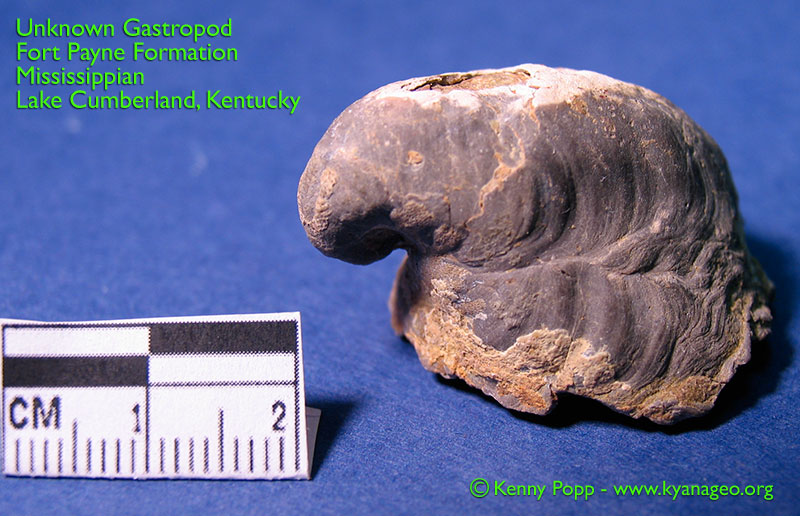
- Unknown snail Fort Payne Formation, Lake Cumberland, Wayne Co., KY


 Sponges (Porifera)
- Hexactinellid sponge root tufts, Middle Mississippian, Muldraugh Formation, Hardin Co., KY
- Hexactinellid sponge spicules, Middle Mississippian, Muldraugh Formation, Hardin Co., KY
- Sponge spicule Middle Mississippian, Salem Limestone, Floyd Co., IN


 Trace Fossils
- Unidentified trilobite trails Branchville, Perry Co., IN

 Trilobites (Arthropoda)
- Phillibole conkini (Hessler), pyritized, Middle Mississippian, Coral Ridge Member, New Providence Formation, Jefferson Co., KY
- Phillibole sp. Morehead, KY


Other Fossils
- Lingula sp. Morehead, KY
- Spirorbus annulatus Hall, annelid, Middle Mississippian, Salem Limestone, Floyd Co., IN


A Note About Fossil Names
Fossils are named like other biological species. The genus and trivial name (for example, Auloceras + undulata) together form the species name. The author’s last name appears in parentheses if the genus name has changed since the original description; it is not in parentheses if the original genus name is still used, as in Favosites niagarensis Hall. A subgenus is sometimes shown in parentheses: Favosites (Emmonsia) emmonsi Rominger, where Emmonsia was originally described as its own genus but has since been folded back into Favosites. If the species name is unknown, “sp.” follows the genus name (for example, Cyclonema sp.).
Fossil names can change as new research is published. We strive to use the most up-to-date names available for the specimens illustrated on our website.
Abbreviations
Common abbreviations used in locality information include: Co. for County, KY for Kentucky, IN for Indiana, IL for Illinois, OH for Ohio, and TN for Tennessee.
Fossil drawings © Michael Popp, 2009.